Push model
Elastic.Channels implements a two-stage buffered push model. Producers write documents into an inbound channel; the library batches, throttles, and exports them concurrently to a backend (Elasticsearch in this case).
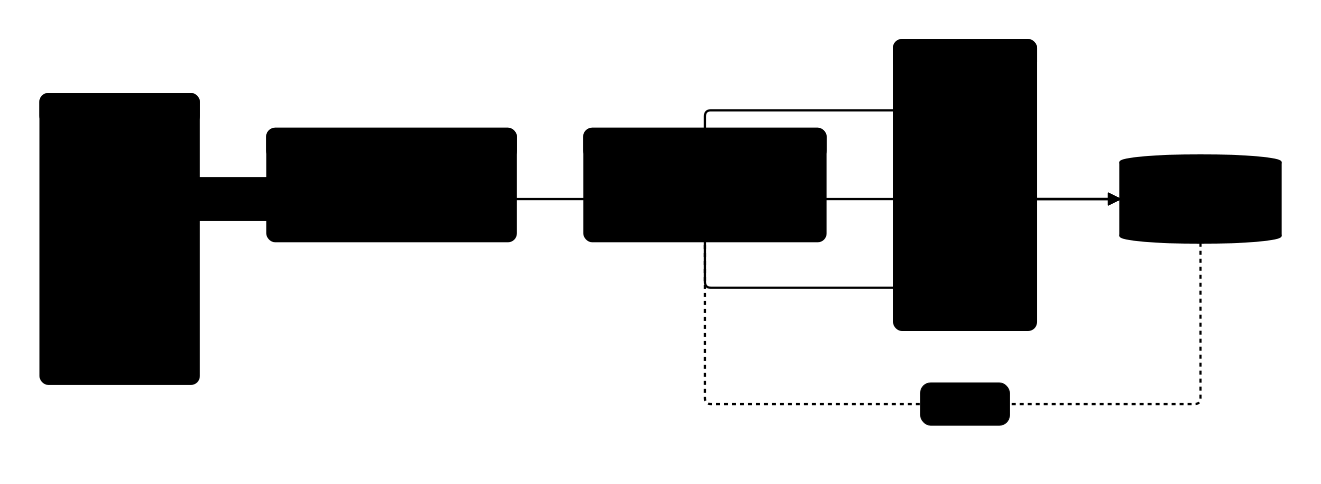
A BoundedChannel<TEvent> accepts writes from any number of producers. The channel capacity is controlled by InboundBufferMaxSize (default: 100,000).
An InboundBuffer accumulates items until one of two thresholds is hit:
- Count threshold: items reach
OutboundBufferMaxSize(default: 1,000) - Time threshold: time since first write exceeds
OutboundBufferMaxLifetime(default: 5 seconds)
The inbound buffer uses ArrayPool<TEvent> to minimize allocations.
When thresholds are hit, the inbound buffer is flushed into an OutboundBuffer (an ArraySegment<TEvent> view over the pooled array). This buffer is written to a bounded outbound channel with capacity MaxConcurrency * 4.
Export tasks read from the outbound channel and call ExportAsync with each batch.
Two modes control behavior when the inbound buffer is full:
| Mode | Behavior |
|---|---|
BoundedChannelFullMode.Wait (default) |
WaitToWriteAsync blocks the producer until space is available |
BoundedChannelFullMode.DropWrite |
Drops the item and invokes the BufferItemDropped callback |
When the number of inflight events approaches InboundBufferMaxSize - DrainSize, WaitToWriteAsync applies incremental 100ms delays (up to 1 second) to slow producers before the channel fills completely.
TryWrite is non-blocking and returns false if the buffer is full.
Export concurrency is calculated automatically:
MaxConcurrency = Min(Ceil(InboundBufferMaxSize / OutboundBufferMaxSize), ProcessorCount * 2)
A semaphore limits the number of concurrent ExportAsync calls to MaxConcurrency. You can override this with BufferOptions.ExportMaxConcurrency.
When an export fails or returns retryable items:
- The channel calls
RetryBufferto determine which items to retry - Retryable items are re-exported up to
ExportMaxRetriestimes (default: 3) - Each retry waits according to
ExportBackoffPeriod(default:2 * (attempt + 1)seconds)
For Elasticsearch specifically:
- HTTP 429 (Too Many Requests) retries the entire batch
- HTTP 500-599 retries individual failed items
- Items with non-2xx status codes that aren't retryable are rejected
WaitForDrainAsync provides graceful shutdown:
await channel.WaitForDrainAsync(TimeSpan.FromSeconds(30), ctx);
The drain:
- Closes the inbound channel (no new writes accepted)
- Waits for all inflight events to be exported
- Waits for all export operations to complete
- Respects the timeout -- returns when complete or when time expires
If maxWait is null, the drain waits indefinitely, scaling the timeout based on the number of pending export batches.
| Option | Type | Default | Description |
|---|---|---|---|
InboundBufferMaxSize |
int |
100,000 | Maximum items queued in memory |
OutboundBufferMaxSize |
int |
1,000 | Maximum batch size per export call |
OutboundBufferMaxLifetime |
TimeSpan |
5 seconds | Maximum time before a partial batch is flushed |
ExportMaxConcurrency |
int? |
Auto-calculated | Number of concurrent export tasks |
ExportMaxRetries |
int |
3 | Maximum retry attempts per batch |
ExportBackoffPeriod |
Func<int, TimeSpan> |
2*(i+1) seconds |
Backoff delay per retry attempt |
BoundedChannelFullMode |
BoundedChannelFullMode |
Wait |
Behavior when inbound buffer is full |
Long-lived (continuous ingestion):
- Create the channel once, write continuously
- Buffer tuning matters: increase
InboundBufferMaxSizeandExportMaxConcurrencyfor high throughput - Call
WaitForDrainAsynconly at shutdown
Short-lived (batch import):
- Create the channel, write a batch, drain, dispose
- Default buffer sizes work well for most batch sizes
- Always call
WaitForDrainAsyncbefore disposing to avoid data loss